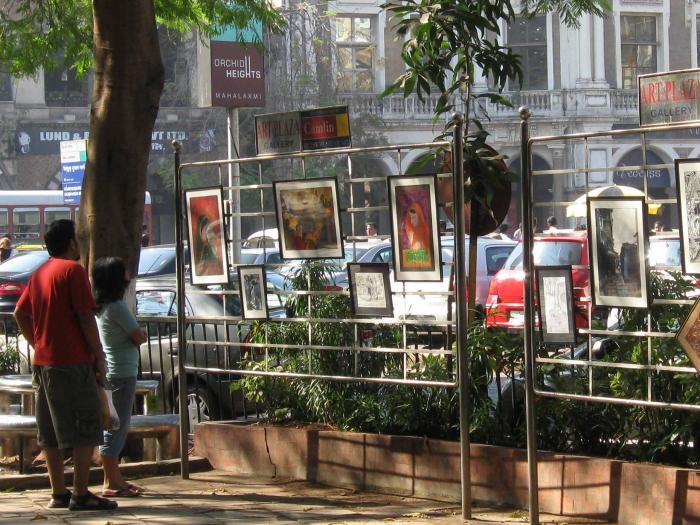
Whenever I am in the Kala Ghoda area of South Mumbai, I always make it a point to visit the Pavement Art Gallery, also known as the Art Plaza. Located outside the Jehangir Art Gallery, this Pavement Art Gallery offers exhibition space for artists to display and sell their works. Not all the stuff is good, but there is always something for everyone. Over the years, I have picked up pen and ink drawings of birds, charcoal sketches of Mumbai’s iconic buildings, as well as some miniature landscape watercolours from here.
So here I was at the Pavement Art Gallery on a January afternoon. It was a pleasant weather day, with a cool breeze blowing. As I was browsing at the paintings, I saw a couple doing the same.
Checking out the art on display at the Pavement Art Gallery
Till about a few years back, we did not have any domestic help at home—either full-time or part-time. It was not because we could not afford one; on the contrary, it was because my mother, who is an intensely private person, could not bear to have any help afoot at home. She abhorred the inevitable gossip that came as a package deal with the domestic helps. We once had a domestic help called Kashibai, who would step into our house and start off on the goings on in the other houses she worked in. Even if we told her that we did not want to hear about the affairs of other houses, she would continue with absolute relish. We were quite sure when she worked in the other houses, she would be speaking about the goings on in our house !
All this led to Amma preferring not to have any domestic help and do all the household work herself. The rest of us would pitch in whenever she let us help her. But with advancing age, this state of affairs could not go on for ever and about 8 years ago, Amma finally agreed to have someone to clean the floors. Then, about 2 years back, she agreed to appoint someone to clean our windows, and recently, she agreed to have part-time help in the kitchen. Each appointment was made after battles galore with Amma, where I simply wore her down with my nagging. Today, Amma has learnt to just about tolerate this intrusion into her privacy for the little time that the domestic helps are there in our house every day. Then about 2 months back something happened that upset this little equilibrium of having part-time domestic help at home.
Imagination is such a wonderful thing isn’t it? We all use it in our own unique ways. I use most of mine to give colour, form and shape to characters, places, and scenes described in books.
I was very fortunate to be smothered surrounded by all sorts of books growing up (and I still am—that is, both growing up and surrounded by books ;-)), which gave ample scope for my imagination. Even today, whenever I read something—even something as dry as a research paper that I am copy-editing—the B&W words on the paper immediately transform into an image matching the description, but shaped my imagination. This whole process is so instinctive and automatic that all I have to do is to pick up something and start reading for the B&W words to coalesce in my mind to form 3D images in full colour. This image could be static or moving; as I continue reading, the images flicker, change, or transform keeping pace with the narrative.
I find it easier to conjure up images of some words and narratives than others. Predictably, familiar contexts and settings, particularly those that I have experienced, are easy to imagine and visualise, but unfamiliar ones present a challenge. But, hey, that’s what a colourful imagination is for, right?
Maha delay in notifying RTE Rules: State’s Slowness Has Ensured That Destitute Kids Won’t Get Admission In Pvt Schools This Year.
This was the headline of an article in the Times of India of June 13, 2011, the day all the State Board schools in Maharashtra re-opened. According to the article, along with 15 other states and union territories of India, Maharashtra had yet to notify the norms of the Right of children to free and compulsory Education Act (RTE), 2009. The RTE Act, which came into operation on April 1, 2010, has the same legal status as other rights enshrined in the Indian Constitution. Two of the defining rules of the Act say that (i) every child from 6 to 14 years of age has the right to free and compulsory education in a neighbourhood school, and that (ii) private schools must take in 25% of their class strength from “weaker sections and disadvantaged groups”, who will be sponsored by the government.
The RTE is a much discussed Act with its share of supporters and critics; one can find many critiques of the Act—you can read an excellent one by Parth Shah here and this blog that is entirely devoted to the RTE. Most of the critiques that I have come across discuss the lack of clarity (particularly with regard to the economics involved) in the rules of the Act as well as its implementation. In an article in Mint Lounge on how an English-medium education is a way out of life in the slums for many, Aakar Patel weaves in how the RTE Act could be used to achieve this goal. He also discusses as well as the possible hurdles in achieving it—hurdles that are not just economic, but social, i.e. those related to caste, class, etc.
In my opinion, the RTE Act is noble and idealistic in intent, but completely un-implementable in letter and spirit. Like Aakar Patel, I too believe that the reasons are not economic, but social due to the class-ridden and casteist nature of our society—a society that very clearly propagates differentiation of an “us” and “them” at every level. I draw from my experience to support this opinion. Let me elaborate.
It had been a hectic Friday at the University and I was glad when I boarded the tube that would take me to Baker’s Street station, which was closest tube stop to where I lived in London. It was a cold January day and all I wanted to do was to get into the warmth of my room. As I hurried towards the exit, I saw a notice on one side and idly glanced at it as I passed it.
What I saw stopped me in my tracks as I had seen nothing like it before. I mean, nothing like it before in India.
I was amazed to not only see an apology over a delay in the services of the Bakerloo Line (of the London Underground) that day, but also the reasons for that delay. And to top it all off, the apology was sincere and a personal one from the General Manager of the Bakerloo Line himself !
Anybody who has travelled by any system of transport in India, would understand why I was so astonished to see the apology. The only thing we get to hear are the “we regret…” or the “hamein khed hai ki…” — a line which is used for delivering a condolence message or delivering automated messages!
Can you imagine seeing such a poster or apology put out by the Indian Railways, or local transport services in the various cities of India?
Christmas Eve 2008. London. At around 7.30 pm that evening, you could have found me at Hyde Park with two friends, Bharath and Krithika. Three Indians with varying degrees of homesickness. Hyde Park was more crowded than usual that day—apart from the casual visitors and walkers and joggers, it was full of revelers at the Christmas Fair being held at the Park. We, too, joined the revelers, but after some time found it unbearably noisy and decided to leave.
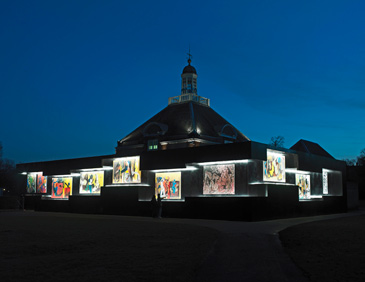
We took a path that appeared to have fewer people and after some time found ourselves in the Kensington Gardens. As we were walking along and chatting about that and this, I suddenly noticed a building in the distance all lit up and covered by what appeared to be extremely colourful graffiti—at least from where we were standing.
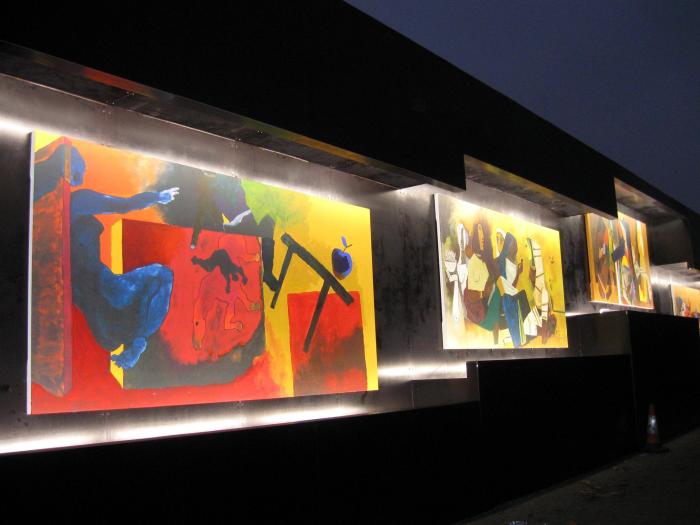
Curious, we decided to investigate. As we walked closer, we discovered that it was not colourful graffiti, but paintings that were hung on the exterior walls of the building. They were glowing in the dark and against the silhouette of the building, it was a sight to behold.
Photograph: Sylvain Deleu. Photo Courtesy: http://www.serpentinegallery.org The exterior walls of the Serpentine Gallery showcase MF Husain’s works
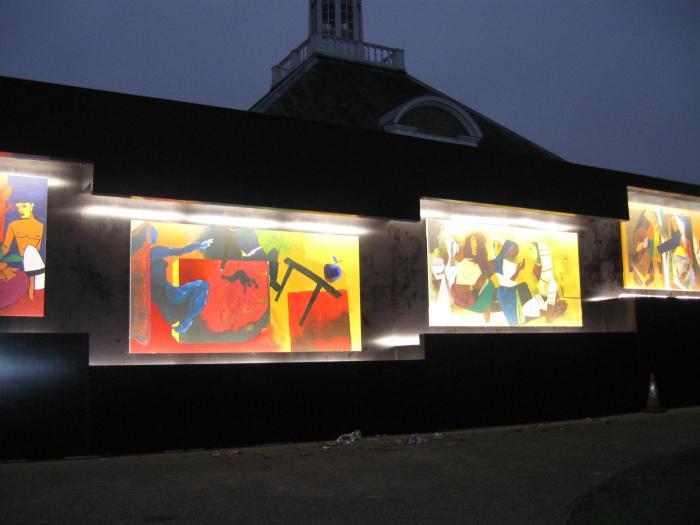
And what an architectural frame! They could not have described it more aptly. It was amazing to see these works of art displayed the way they were, outside the confines of a sterile, gallery interior. Once I got over the unexpected shock of seeing Husain’s works displayed as such, I was able to just stand back and enjoy them. Even though it was quite cold that evening, just looking at the pictures warmed me up.
Reds, yellows, oranges and blues. All my favourite colours in one frame
Allowing Husain’s vibrant and colourful paintings to surround me with their warmth, I felt some of my homesickness dissipate, and suddenly cold, grey, sunless London was bearable. I sent a heartfelt, but silent thank you to MF Husain for making me feel happier than I had felt in days.
Yesterday, when I read of MF Husain’s death, I immediately remembered that evening when he, or rather his paintings, helped me tide over homesickness. For someone who was hounded in the country of his birth, forced to give up his citizenship, publicly declared his homesickness and yearn to come back to India—I wonder what comforted him and kept him going.





 This was
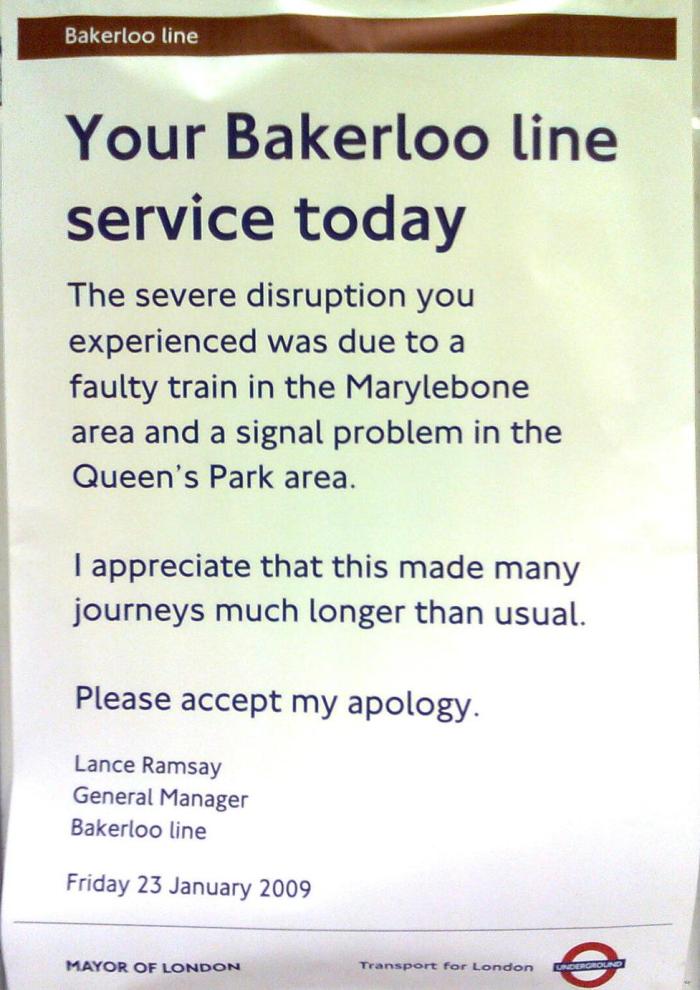 I was amazed to not only see an apology over a delay in the services of the


 My Favourite Things