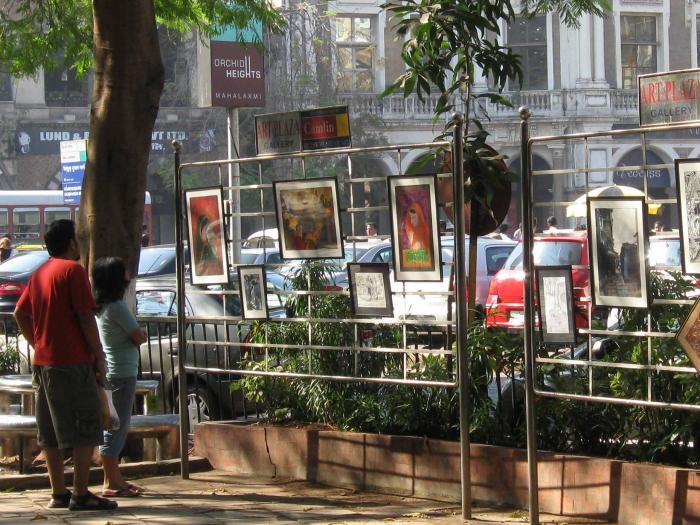
Whenever I am in the Kala Ghoda area of South Mumbai, I always make it a point to visit the Pavement Art Gallery, also known as the Art Plaza. Located outside the Jehangir Art Gallery, this Pavement Art Gallery offers exhibition space for artists to display and sell their works. Not all the stuff is good, but there is always something for everyone. Over the years, I have picked up pen and ink drawings of birds, charcoal sketches of Mumbai’s iconic buildings, as well as some miniature landscape watercolours from here.
So here I was at the Pavement Art Gallery on a January afternoon. It was a pleasant weather day, with a cool breeze blowing. As I was browsing at the paintings, I saw a couple doing the same.
Checking out the art on display at the Pavement Art Gallery
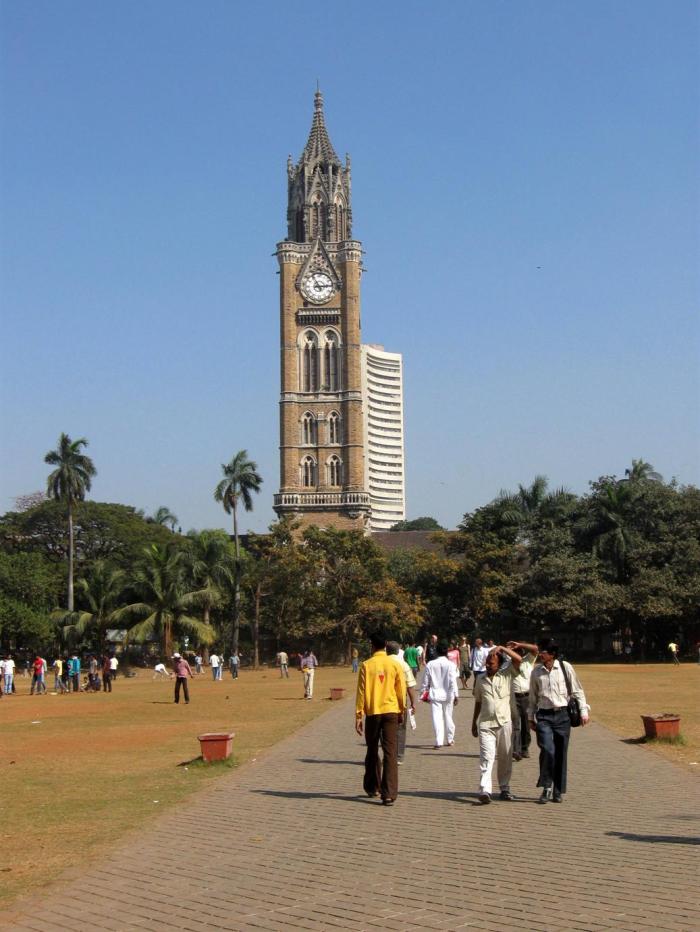
It was a warm Saturday afternoon in February, and I was spending the day wandering about in the Churchgate-Fort-Kala Ghoda area in south Mumbai and photographing anything that caught my fancy. After a nice lunch at the Tea Centre in Churchgate, I decided to cross the Oval Maidan from the Churchgate side to the University of Mumbai side.
As I walked along Oval Maidan, the iconic Rajabhai Tower and Bombay Stock Exchange Building stood tall with their contrasting architectural styles. Once I entered the Oval Maidan it was the cricket matches being played that caught my attention. It was only after a while that I looked up and saw this.
The Rajabhai Tower (left) and the Bombay Stock Exchange Building (right) appear to be fused together from this perspective!
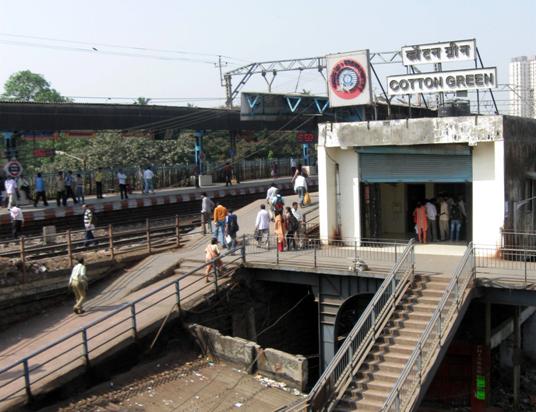
An article titled “Walking all over locals’ lives” in today’s The Times of India talks about how the construction of (some) skywalks in Mumbai has led to the loss of privacy for residents who live along the skywalks as passers-by on the skywalk can look into the houses level with the skywalk. My recent visit to the Cotton Green Skywalk underscores this observation. Take a look at the picture below.Looking in, not looking out
Now, the Cotton Green Skywalk does not really pass within handshaking distance of the houses like the ones mentioned in the article, but it is still uncomfortably close. Without any effort whatsoever, I was able to hear every cuss word hurled between two neighbours quarreling over something (over and above the traffic din); and saw a man tying his pajamas, and another one reading his morning newspaper. And no, tempting as it was, I didn’t photograph any of these. I felt guilty enough witnessing this!
Last Saturday I went skywalking at Cotton Green. Till very recently what I knew about Cotton Green could actually fall within the 140 characters of a Twitter update—it is an eastern suburb of Mumbai, a station on Central Railway’s suburban Harbour line, and home to the stunning art noveau Cotton Exchange Building, that I would always look out for whenever I crossed the station. That’s it. It was not really interesting enough to get off and go exploring.
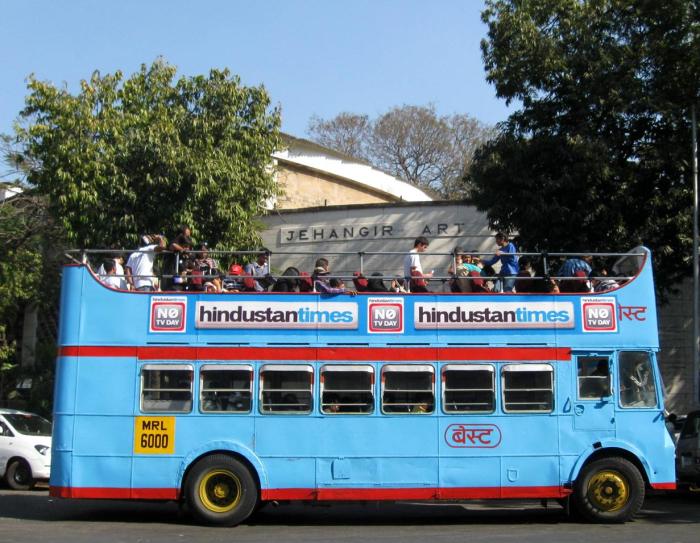
Mumbai’s BEST buses are known for their trademark red coloured buses, But only when they are not covered with advertisements, or have their AC buses painted a hideous purple. But one day, about two months back, I saw a new colour on the BEST bus. A lovely new, fresh, colour.
29 January 2011: An open deck, double-decker, BEST tourist bus outside Jehangir Art Gallery
“I couldn’t tear myself away from the image of the Maheshmurti. It was so beautiful. So mesmerising. Elephanta was so nice,” gushed Iskra, an exchange student from Bulgaria.
I listened to Iskra’s description of her visit to Elephanta Caves with part fascination and part envy. The reason? In spite of having lived in Mumbai for nearly 23 years, I had never been to the Elephanta Caves. Listening to Iskra, and that too a foreigner, rave about them needled me into resolving to visit the caves at the earliest opportunity.
And would you believe it? The opportunity presented itself to me the very next day, almost as if it was just waiting for me to make up my mind. My Facebook wall announced that Girls on the Go (GOTG), a women’s only travel club, was conducting a guided day trip to the Elephanta Caves on 13 March 2011. Would I be interested? Not one to let go of an opportunity like this, I signed up for the trip within seconds of seeing the intimation. 😀
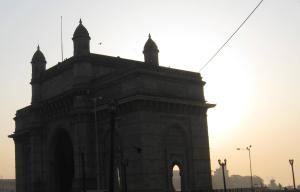
Gateway of India
So, on D-Day, I was at the Gateway of India much before the reporting time of 7.45 am. While waiting for Piya Bose, the founder of GOTG, and the rest of the group to assemble, I tried to recall what I knew about the Caves. They were … um… really old rock-cut caves, were located in Elephanta Island some distance away from Mumbai, could be accessed only by boat, and was a UNESCO World Heritage Site. In short, I knew nothing about the Caves. Of course, by the time the tour got over I was a little wiser thanks to Lakshmi Kishore, our guide, and a booklet on the Elephanta Caves that I purchased from the ticket office.
Elephanta Island has traces of habitation from 2nd century BC in the form of remains of a Buddhist stupa, reportedly built by Emperor Ashoka himself. But what the Island is really famous for are 7 rock-cut caves, whose age is not well established due to absence of written records. Various theories exist as to the age of the caves as well as to who built them, and according to the Archaeological Society of India’s (ASI) booklet, the caves were excavated during the middle of the 6th century, during the rule of the Konkan Mauryas.
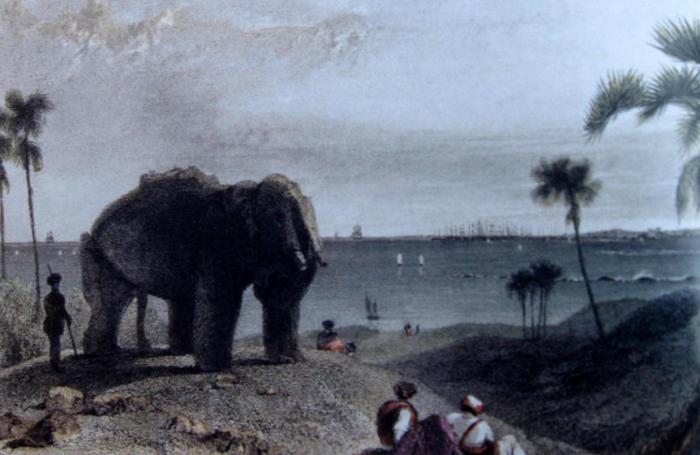
Locally, Elephanta Island is known as Gharpuri and is located about 11 km from Mumbai. It was called Elephanta by the Portuguese, who found a stone statue of an elephant at one of the entry points to the Island. Though they tried their best to destroy the statue, they only succeeded in severely damaging it and today the restored elephant is installed at the Bhau Daji Lad Museum in Mumbai.
Aquatint of the Stone Elephant by Thomas Daniell and William Daniell, 1786. Photo Courtesy: Elephanta by George Michell






 My Favourite Things