I first heard about Mahabalipuram in a chapter of my Class 8 or 9 Hindi textbook. While I don’t remember who the author of that piece was, I do remember that it was about the ruminations of a sculptor who wondered about the glorious temple ruins by the sea-shore and how they came to be.
Though the chapter didn’t mention Mahabalipuram as the place the sculptor was talking about, my Hindi teacher said that is where the story was based. He also elaborated a bit on the history of Mahabalipuram and that had me hooked. My young and impressionable teenaged mind found the description of a bygone era and the desolation of temple ruins by the sea-shore very romantic.
The visual stayed with me through school, college, university… till I actually visited Mahabalipuram in 1996. This was in the summer of that year and the heat and tourist hordes dispelled any romantic notion I had about Mahabalipuram. But the monuments left an impression on me — enough to make me want to re-visit it.
It took me almost 20 years visit Mahabalipuram again.
Madurai is home to a number of sacred sites whose origins have now passed into the land of myth and legends. The original temple structures built on the sacred sites no longer exist today for over the centuries, they have been added to or rebuilt or renovated to become the temple complexes they are today. Along the way their myths, legends and history have intertwined to create a tradition of rituals and festivals that continue to present day.
The Kallazhagar and Koodal AzhagarKovils are two such temples in Madurai. Both are Vishnu temples and are part of the 108 divya desams or divya kshetrams — temples mentioned by the Alvars or the poet-saints of the Srivaishnava tradition. The main deities in both the temples are called Azhagar, which means beautiful / handsome in Tamil. Both the Azhagar Kovils have their own unique origin story or sthalapuranam, and are significant in understanding the region’s political history, religious traditions, and architectural landscape.
Let us first begin with an exploration of the KALLAZHAGAR KOVIL.
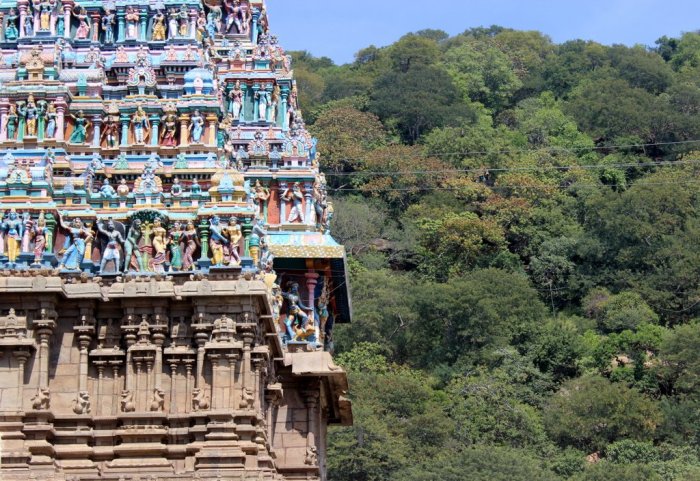
The Kallazhagar Kovil and its setting in the lush green Azhagar Malai in the background
Earlier this year, on the 2nd of January, I took a flight out of Mumbai for Chennai to join a small group of music and culture enthusiasts for a 3-day tour of Madurai.
Known variously as Halasya Kshetram, Koodal Nagaram, Aalavai and Kadamba Vanam, among others, Madurai is better known today as a temple town and is synonymous with the Meenakshi Amman Kovil. But Madurai has rich history that predates the temple and one that goes back to more than 2,000 years making it one of the oldest cities in the country. The city has been the seat of Tamil literature, culture, learning, politics, religion, and more.
An overnight train journey later, our group was in Madurai looking forward to exploring the city and getting to know it better. This was my second trip to Madurai, but it could very well have been my first for the previous visit in 2005 was only about visiting the Meenakshi Temple ! This trip, too, began with a visit to the Meenakshi temple — considered to be the heart of the city and the point from where the city is believed to radiate out like a lotus — before we moved on to explore other parts.
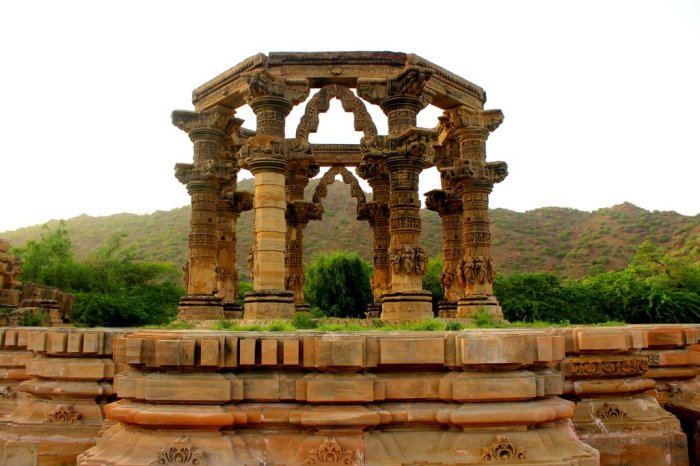
About 180 km south-west of Jaisalmer, where the Thar Desert meets some isolated outcrops of the Aravalli mountain ranges, lie the ruins of the temples of Kiradu. It is believed that there were around 108 temples on this site, but today only 5 temples remain — 4 of those are dedicated to Shiva and 1 temple is believed to have been dedicated to to Vishnu.
I first heard about the temples at Kiradu when I received an invitation from Suryagarh. The itinerary attached with the mail included a visit to these temples. I was intrigued enough to look up for more information on the internet immediately — even before I accepted the invitation. To my surprise, I found little substantive information online. This only made the temples more intriguing and mysterious for me and I couldn’t wait to see them for myself when I visited Suryagarh in July 2016.
And after lunch on my last day at Suryagarh, we set off to see the Kiradu temples. It was a beautiful, but long, drive through the Thar, through dramatic changes in the landscape from desert to hilly.
It was around 6 pm when we arrived at the Kiradu temples, which meant I had an hour or so before sunset and before the light faded. The next hour saw me racing from temple to temple, pumped with adrenaline, trying to take in as much of the details as I could and photographing whatever I thought was interesting or significant.
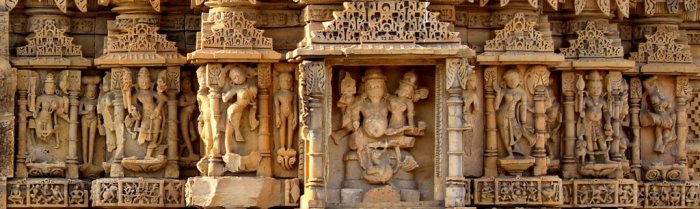
A nritya (?) mandapa with elaborately carved toranas and pillars. One of the pillars has been reconstructed as part of the restoration work undertaken by the ASI at Kiradu
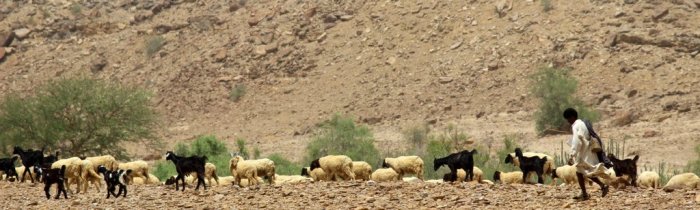
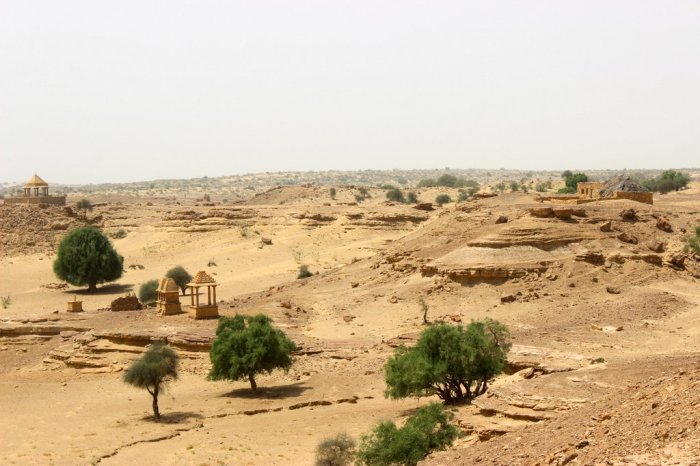
The mid-day sun in July is hot and harsh as is the landscape around. I am somewhere in the Thar Desert — about 30-40 km west of Jaisalmer city — and the ground is hard, dry, and stony in most parts with some sandy patches. It is the end of summer in this region and I scan the skies for signs of monsoon clouds, but there are none to be seen.
All around me are limestone and sandstone ridges with the meanders of rivers and streams that once flowed here cutting through the rock layers. In the distance, cenotaphs and memorial stones to the dead can be seen. The occasional pops of green from the desert flora provides visual relief (and shade !) in the otherwise arid and barren landscape (see photograph below).
Millions of years in this one frame !
It is a sight that leaves me awestruck for this one frame encapsulates millions of years of history of the region — natural as well as human. A history that is as rich as it is varied and one that has changed and evolved through space and time.







 My Favourite Things