Do you like winter?

The "Symmetrical" Tree at Regent's Park

One morning in early November, about 2 years back, I decided to go for a walk. At that time, I was living in London. I didn’t have to go too far as Regent’s Park was next door to where I was staying.

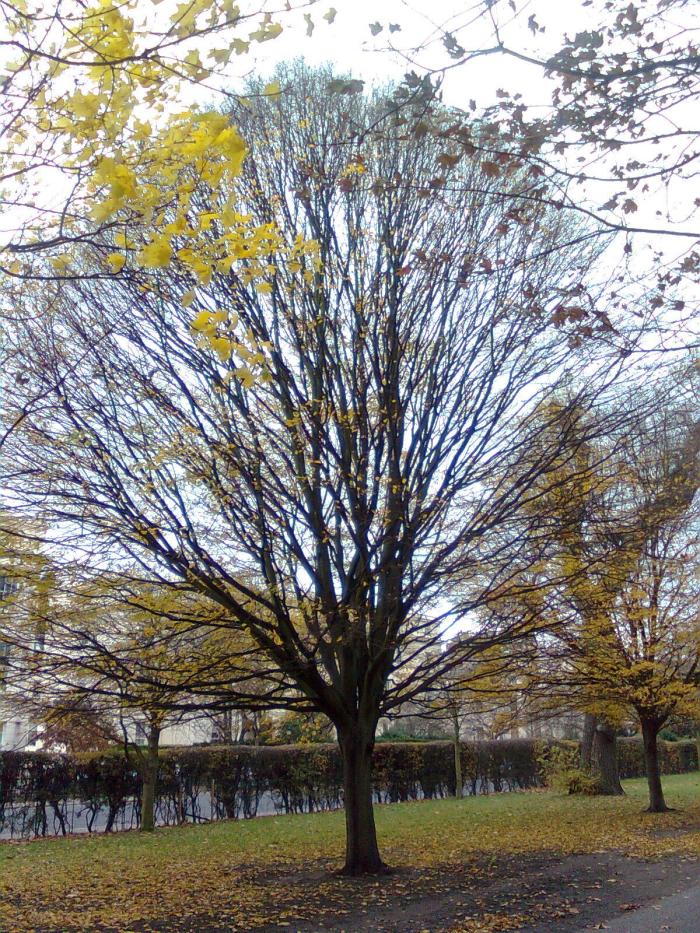
I took my camera with me as I intended to photograph some of the beautiful trees in the park, particularly those trees, which had exposed a stunningly symmetrical structure after shedding all their leaves (see photo on the left).

After a leisurely stroll through the Park, I arrived at the place where I had noticed these trees. There was no one else nearby, save an elderly man who was well wrapped up against the cold. As I overtook him, I murmured a “Good Morning” to which I received a acknowledging nod.

I moved towards the trees and was soon clicking away. After a few minutes, I sensed someone close by watching me. I turned around to see that the elderly man, I had just greeted, had walked up to see what I was photographing.

He asked me gruffly, “Young lady, why are you photographing that tree? It’s bare !”

Continue reading “Do you like winter?”

132 steps to Vaikuntha

I was introduced to board games as a child by my maternal paati (grandmother in Tamil), Meenakshi R. She loved them and could spend the whole day playing different games with her grandchildren or whoever was free and willing. I wasn’t always free, but I was always willing 🙂

We played games like pallankuzhi (a traditional game played with shells and cowries), ludo, snakes and ladders, etc. If I ever got bored playing the same games, she would quickly improvise games on the floor with some pieces of chalk, some string, and other odds and ends that would magically appear from her cupboard. The games were never just games—they were also stories, anecdotes, strategies, wins and losses, all delivered while playing.

Paati died when I was 8, and after her death, playing board games was never the same again—none of my family members or friends could match her enthusiasm and delight for the games. Besides, with school and other growing up activities, playing board games took a back seat.

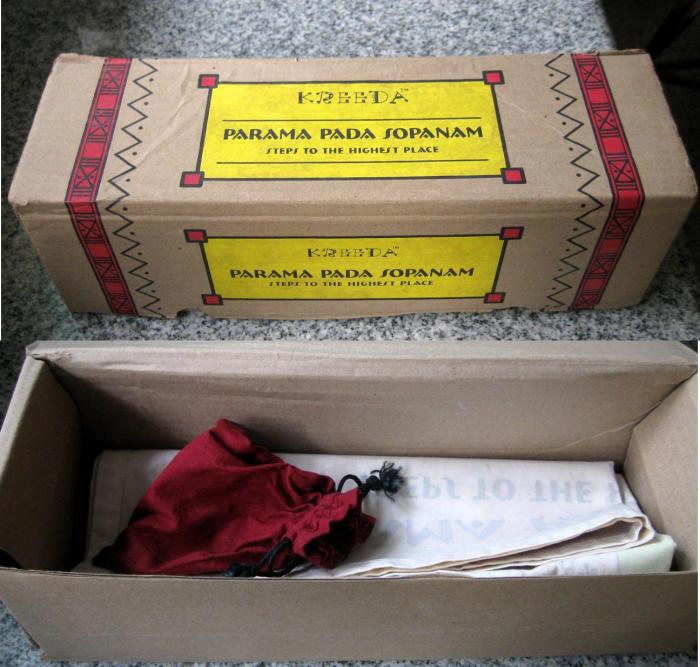
I resumed my love affair with board games some years back after a chance visit to The Design Store in Bangalore. Tucked away amongst all their furniture and furnishings and knickknacks, was a shelf displaying traditional games from Kreeda. One of the games was Parama Pada Sopanam. Intrigued by the name, I opened the display pack.

Top: The "boxed" game. Bottom: The box opens to reveal a little cloth pouch containing little wooden counters, two elongated metal dies, and an information booklet (not in picture)
Top: The “boxed” game. Bottom: The box opens to reveal a little cloth pouch containing little wooden counters, two elongated metal dies, and an information booklet (not in picture)

Continue reading “132 steps to Vaikuntha”

Just wondering… Why are men offered prasad in temples first?

I am an occassional, rather than a regular, temple-goer. And when I do go to one, it is to the Sharadamba Temple in Chembur, Mumbai. I like this particular temple because it is quiet, peaceful, and most importantly, very clean—it is a pleasure to walk on the cool granite floors. Another reason I go to this temple is because it is never crowded, except on festival days like Navratri and  Mahashivratri, and even then it is never unbearably so.

The Sharadamba Temple is one large hall with the entrance at one end and the Sharadamba deity at the other end. A simple wooden barrier separates the devotees from the sanctum sanctorum. Like in most temples, the men flock on one side of the hall and the women on the other side, though there is no physical barrier to separate the two sexes. The children, of course, keep running between the two sides.

Over the years that I have been going to this temple, I have noticed something very curious at this temple. After the aarti is over, the priest always offers it to the assembled men first, in particular the office bearers/trustees of the temple. Only then does the aarti thali come around to the women’s side. This is the case with the teertham (holy water), the prasad, as well as the flowers.

Continue reading “Just wondering… Why are men offered prasad in temples first?”

What’s in a name?

None of us have a say with what we are named as, do we?

It depends entirely on what our parents (or whoever else had a say in this matter) wanted to name us. But sometimes, even the parents (or whoever else had a say in this matter) do not have a choice in choosing their child(ren)’s name(s). For instance, the Tamil Brahmin (a.k.a. TamBrahm) Iyer community from Tirunelveli district of Tamil Nadu, follows certain pre-ordained rules. You wouldn’t find these rules in any book or magazine, as it is part of the oral traditions of the community passed down from generation to generation.

I make an attempt (albeit a tongue-in-cheek one) here to codify these “scientific”, and quirky, rules on naming children born to the TamBrahms of Tirunelveli district. My qualifications for doing so are due to my being (i) a TamBrahm from Tirunelveli District, and (ii) a recipient of this oral tradition. 🙂

Some common TamBrahm names. Designed with the help of Wordle

Continue reading “What’s in a name?”

Who’s no. 2 ?

What does a newspaper do if it can’t fight for the No. 1 position?

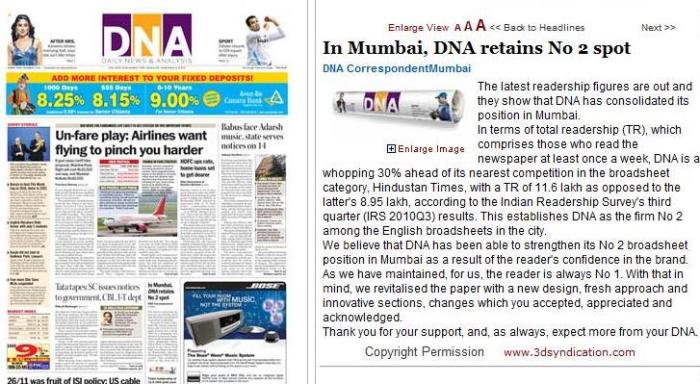
It fights for the No.2 position as illustrated by articles in today’s newspapers of both the DNA and Hindustan Times. Using data from the 2010 Indian Readership Survey (IRS), both broadsheets have claimed that they are the No.2 broadsheet in Mumbai.

The IRS results are awaited every year by advertisers and newspapers alike. The ranking of newspapers is important for both groups as it determines advertising rates and is also an indication of the reach of the particular newspaper. 

In a front page article titled, “In Mumbai, DNA retains No.2 spot” claims, the DNA says that it is

30% ahead of its nearest competition in the broadsheet category, Hindustan Times, with a TR [total readership?] of 11.65 lakhs as opposed to the latter’s 8.95 lakhs, according to the Indian Readership Survey’s third quarter results.

Continue reading “Who’s no. 2 ?”

Heidi: My friend, philosopher and guide

Heidi was the first book ever purchased for me. I was about 6 or 7 years old at that time, the same age that Heidi is when her story begins. Heidi was also the 16th and the 73rd book bought for me. Yes, you read it right. Till date, I have owned 3 Heidi books and each one has a story attached to it.

Heidi-1 was with me for just a day. Raju, my maternal uncle, had just received his first pay cheque and in a fit of generosity decided to buy something for his 8 nephews and nieces. So what does he do? He goes and buys some books, one of which is Heidi. Only, Heidi is not one book here — it is a serialised version spread over 6 palm-sized books with tiny illustrations and microscopic lettering. He then distributes these 6 “Heidis” to 3 of his nieces and nephews in a random manner. I am one of the recipients and get books 2 and 5 of Heidi.

We 3 recipients of the Heidi books were so thrilled with the gift that neither its random distribution nor the impossibly small lettering bothered us. We could squint and read, couldn’t we? It was a Saturday that day, so we didn’t have to worry about school either. After lunch that day, we got down to reading the books in serial order, with each one reading his or her books aloud for the others. I still remember the instant connection I felt with Heidi — her spirit, loyalty, adventures and love for her family and friends proved irresistible. At the risk of sounding corny, I knew that I had made a friend.

I am not sure whose mother discovered the books that evening. The small lettering was deemed unsuitable for us children and were confiscated, never to be seen again. My poor uncle got an earful from all our mothers for buying something so child-unfriendly. And that was the rather dramatic end of Heidi-1.

Continue reading “Heidi: My friend, philosopher and guide”